I. Introduction: The Critical Role of Valve Selection in Industrial Systems
Valves serve as the “control nodes” of industrial fluid systems, regulating the flow of liquids, gases, and slurries across sectors ranging from oil and gas to municipal water treatment. Among the most widely used valve types, gate and globe valves dominate applications requiring reliable shutoff or precise flow control—but their distinct designs and performance characteristics make them suited for vastly different scenarios. Choosing the wrong valve type can lead to catastrophic consequences: a mismatched valve in an oil pipeline can increase leakage risk by 300%, while an ill-suited valve in a power plant’s steam system may reduce energy efficiency by 15% and cut equipment lifespan by 50%.
Industry data underscores the cost of poor selection: the global industrial valve market loses an estimated $2.8 billion annually to premature failures, maintenance overruns, and operational inefficiencies—60% of which stem from incorrect valve-type choices. Gate valves, with their linear motion and full-port design, excel at unobstructed shutoff in large-diameter pipelines, while globe valves, featuring rotational disc motion and throttling capability, are the gold standard for precise flow regulation in process systems.
This article delves into the core differences between gate and globe valves, focusing on design principles, performance metrics, application suitability, cost analysis, and maintenance requirements. It also highlights how TIANYU’s custom-engineered gate and globe valves address industry-specific pain points, ensuring optimal performance, compliance, and cost-effectiveness for international clients.
II. Core Design Principles: What Sets Gate and Globe Valves Apart
The fundamental distinction between gate and globe valves lies in their internal structure, which dictates their operating mechanism, flow characteristics, and functional strengths. These design differences are not arbitrary—they are engineered to solve specific industrial challenges, from maximizing flow capacity to enabling fine-tuned flow adjustment.

II.A. Gate Valve Design: Linear Motion for Unobstructed Flow
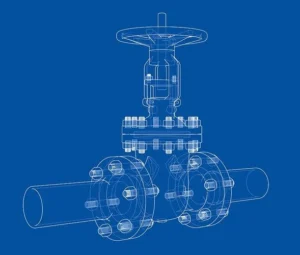
A gate valve derives its name from the rectangular or wedge-shaped “gate” (or disc) that moves linearly (up and down) to open or close the flow path. This linear motion, driven by a handwheel or actuator turning a threaded stem, creates a full, unobstructed passage when open—making gate valves ideal for applications where low flow resistance is critical.
Key design components and their functions:
-
Gate (Disc): Available in two primary designs—solid wedge and flexible wedge. Solid wedge gates (used for clean fluids like water) have a single-piece construction with a 5–10° seating angle, ensuring tight shutoff at pressures up to PN100. Flexible wedge gates (for corrosive or high-temperature fluids) feature a split design that compensates for thermal expansion, reducing binding risk by 40% compared to solid wedges.
-
Valve Body: Typically cast from ductile iron (ASTM A536) for municipal applications or 316L stainless steel (ASTM A351 CF8M) for chemical processing. The body’s full-port design (bore diameter equal to pipe diameter) minimizes flow restriction, with a flow resistance coefficient (ζ) of 0.1–0.3—3–10x lower than globe valves.
-
Stem and Actuation: Rising-stem designs (stem moves up when open) provide visual confirmation of valve position, critical for manual operation. Non-rising stems (stem rotates without moving axially) are used in tight spaces (e.g., underground valve boxes) and reduce overall valve height by 30% for DN300+ sizes.
-
Seats: Metal seats (Stellite 6) for high-temperature/pressure applications (up to 450°C, PN100) or elastomeric seats (EPDM) for low-pressure potable water systems (ANSI Class VI shutoff).
A key design limitation of gate valves is their inability to throttle flow: partial opening causes the gate to vibrate (due to turbulent flow), leading to seat erosion and reduced service life by 50% or more. This restricts their use to “on/off” applications rather than flow regulation.
II.B. Globe Valve Design: Rotational Motion for Precise Throttling
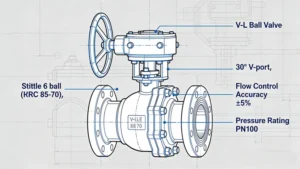
A globe valve features a spherical body (from which it takes its name) and a disc that moves perpendicular to the flow path, creating a variable orifice to regulate flow. The disc is attached to a stem, which is turned by a handwheel or actuator to raise or lower the disc relative to a fixed seat—enabling fine-tuned control over flow rates.
Key design components and their functions:
-
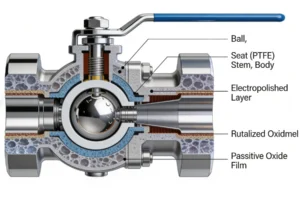
Disc and Seat: The disc (flat, plug, or needle-shaped) mates with a circular seat to form a seal. Needle discs (used for precise regulation) have a tapered design that reduces flow in increments as small as ±2%, while flat discs (for general shutoff) provide ANSI Class V tightness. Seat materials include PTFE (for chemical resistance) and Stellite 6 (for high-temperature steam).
-
Valve Body: The body’s “Z-shaped” or “Y-shaped” flow path creates a natural pressure drop, which facilitates throttling but increases flow resistance (ζ = 3.5–5.0). Y-pattern globe valves (flow path at 45°) reduce ζ by 25% compared to Z-pattern designs, making them suitable for higher-flow applications.
-
Stem and Bonnet: Most globe valves use rising stems for precise position control—each full rotation of the handwheel moves the disc 1–2 mm, translating to predictable flow adjustments. The bonnet (bolted or welded) is sealed with a packing gland (graphite or PTFE) to prevent stem leakage, a critical feature for toxic or flammable fluids.
-
Cage Guided Design: Industrial-grade globe valves often include a cage around the disc, which reduces vibration during throttling and extends seat life by 60% compared to non-guided designs. The cage also simplifies maintenance—discs can be replaced without removing the entire valve from the pipeline.
The globe valve’s design tradeoff is higher pressure drop and energy consumption: a DN100 globe valve in a 10 bar system creates a 1.5 bar pressure drop, requiring larger pumps to maintain flow rates—adding 10–15% to operational costs compared to gate valves.
III. Performance Metrics: A Data-Driven Comparison
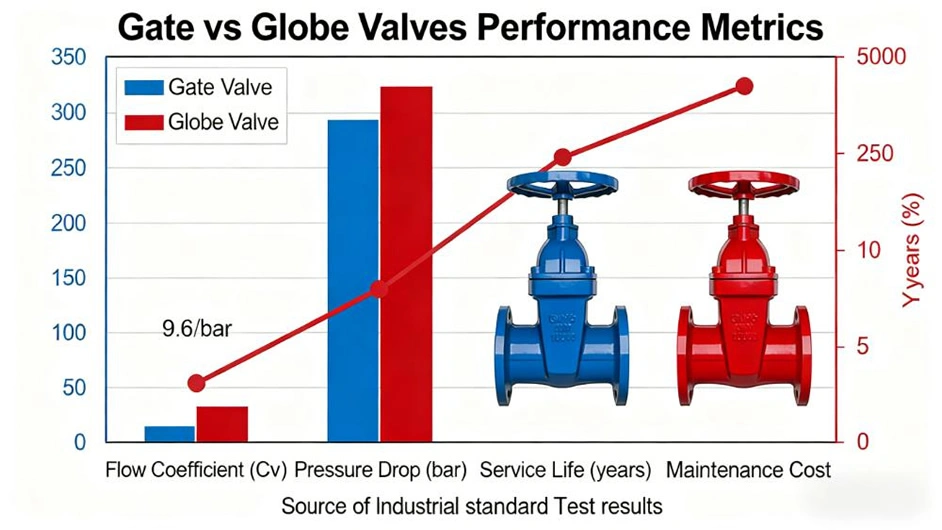
Industrial buyers evaluate valves based on quantifiable performance metrics that directly impact system reliability, efficiency, and cost. Below is a side-by-side comparison of gate and globe valves across 8 critical parameters, using data from DN100 valves (a common industrial size) operating at 10 bar and 25°C unless specified otherwise.
III.A. Flow Capacity and Resistance
Flow capacity is measured by the flow coefficient (Cv), which represents the volume of water (in gallons per minute) that passes through a valve at a 1 psi pressure drop. Higher Cv values indicate greater flow capacity and lower energy consumption.
|
Metric
|
Gate Valve (Full-Port)
|
Globe Valve (Z-Pattern)
|
Globe Valve (Y-Pattern)
|
|---|---|---|---|
|
Flow Coefficient (Cv)
|
300
|
80
|
100
|
|
Flow Resistance Coefficient (ζ)
|
0.2
|
4.0
|
3.2
|
|
Pressure Drop (100 m³/h flow)
|
0.1 bar
|
2.0 bar
|
1.6 bar
|
|
Pump Energy Requirement (10-year operation)
|
$8,500
|
$22,000
|
$18,000
|
For large-diameter pipelines (DN300+), the energy gap widens further: a DN400 gate valve has a Cv of 1,500, while a DN400 globe valve (Y-pattern) has a Cv of 450—requiring a pump 3x larger to achieve the same flow rate.
III.B. Shutoff and Leakage Performance
Shutoff performance is defined by ANSI/FCI 70-2 leakage classes, with Class VI representing the tightest shutoff (≤0.0001% of full flow). This is critical for applications where fluid loss (e.g., toxic chemicals) or system contamination (e.g., potable water) must be avoided.
-
Gate Valves: Achieve ANSI Class IV to VI shutoff, depending on seat material. Metal-seated gate valves (Stellite 6) typically reach Class IV (≤0.01% leakage), while elastomeric-seated versions (EPDM) meet Class VI. A DN100 EPDM-seated gate valve leaks ≤0.0003 GPM when closed—negligible for most applications.
-
Globe Valves: Consistently achieve ANSI Class V to VI shutoff due to their perpendicular disc-seat contact. Needle-disc globe valves with PTFE seats can even reach Class VI with ≤0.00005% leakage, making them the top choice for high-purity applications (e.g., pharmaceutical water systems).
A key caveat: gate valves require 2–3 full turns of the handwheel after seating to ensure tight shutoff, while globe valves achieve proper seating with 1–2 turns—reducing operator error in manual systems.
III.C. Pressure and Temperature Ratings
Both valve types are available in multiple pressure classes, but gate valves excel in ultra-high-pressure applications due to their robust linear sealing mechanism. Temperature ratings are primarily determined by seat and body materials.
|
Valve Type
|
Max Pressure Rating (PN)
|
Max Temperature (Metal Seats)
|
Max Temperature (Elastomeric Seats)
|
|---|---|---|---|
|
Gate Valve (Trunnion-Mounted)
|
PN100 (100 bar)
|
450°C
|
120°C
|
|
Globe Valve (Cage-Guided)
|
PN64 (64 bar)
|
400°C
|
100°C
|
For reference, a trunnion-mounted gate valve with PN100 rating can withstand the pressure of deepwater oil wells (up to 10,000 psi), while globe valves are typically limited to midstream pipeline applications (up to 6,000 psi).
III.D. Service Life and Wear Resistance
Service life is heavily influenced by application: gate valves last longer in on/off service, while globe valves excel in throttling scenarios. Wear primarily occurs at the seat-disc interface and stem packing.
-
Gate Valves: 15–20 years in on/off service (e.g., municipal water mains) with 100,000+ open-close cycles. Service life drops to 5–8 years if used for throttling, as partial opening causes gate vibration and seat erosion.
-
Globe Valves: 10–15 years in throttling service (e.g., chemical process lines) with 50,000+ cycles. Cage-guided designs extend life by 60% compared to non-guided versions, as the cage protects the disc from turbulence.
Abrasive fluids (e.g., wastewater with 5% solids) reduce life for both types: gate valves last 3–5 years, while globe valves (with hardened Stellite seats) last 4–6 years—making globe valves more durable in harsh, throttling environments.
III.E. Maintenance Requirements and Costs
Maintenance costs account for 60–70% of a valve’s total cost of ownership (TCO) over 10 years. Gate valves require less frequent maintenance but more extensive repairs when issues arise, while globe valves have higher routine maintenance but simpler fixes.
|
Maintenance Task
|
Gate Valve
|
Globe Valve
|
|---|---|---|
|
Packing Replacement Frequency
|
Every 2–3 years
|
Every 1–2 years
|
|
Seat Replacement Frequency
|
Every 5–8 years
|
Every 3–5 years
|
|
Average Repair Cost (DN100)
|
$1,200 (requires valve removal)
|
$400 (cage/disc replaceable in-line)
|
|
10-Year Maintenance Cost
|
$3,800
|
$3,200
|
IV. Application Suitability: Matching Valves to Industrial Needs
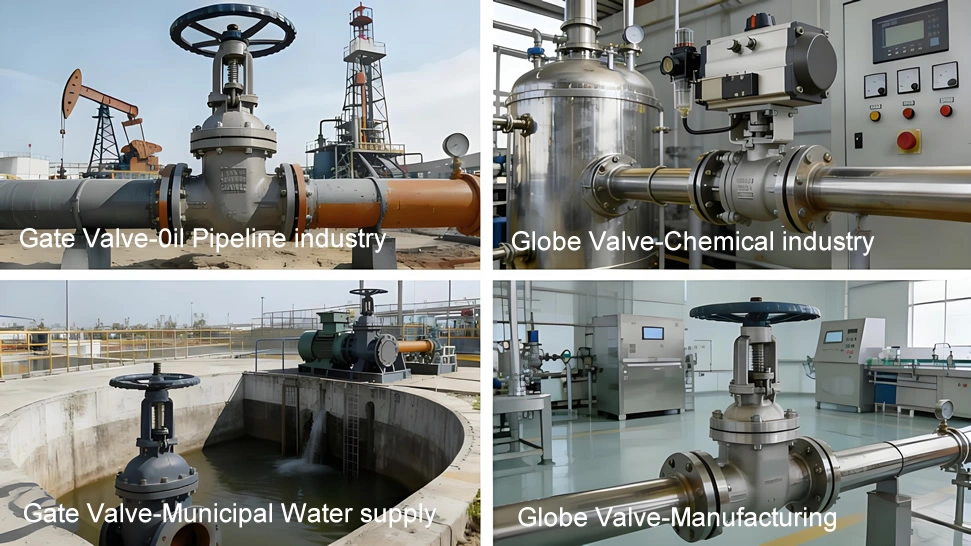
The decision between gate and globe valves hinges on the application’s core requirements: flow control type (on/off vs. throttling), fluid properties (clean vs. abrasive), pressure/temperature, and cost constraints. Below are the most common industrial scenarios and the optimal valve choice for each.
IV.A. Oil and Gas Industry
The oil and gas sector demands valves that handle high pressure (up to PN100), corrosive fluids (crude oil, natural gas), and frequent on/off cycles. Two key applications dominate:
-
Pipeline Shutoff (Midstream): Gate valves (trunnion-mounted, PN64–PN100) are preferred for mainline isolation. A DN400 gate valve in a cross-country pipeline can handle 80 bar pressure and 120,000 open-close cycles before seat replacement. Case study: A Texas pipeline operator replaced globe valves with gate valves, reducing pressure drop by 80% and cutting pump energy costs by $450,000/year.
-
Wellhead Throttling (Upstream): Globe valves (Y-pattern, Stellite seats) regulate flow from wells to separators, with needle discs enabling ±1% flow adjustment. A North Sea wellhead uses DN50 globe valves to control 70°C crude oil, achieving 5 years of service with minimal maintenance.
IV.B. Municipal Water and Wastewater
Municipal systems prioritize cost-effectiveness, tight shutoff (to prevent water loss), and durability in buried or outdoor installations. Gate valves dominate here, with globe valves used for specific regulation tasks:
-
Water Distribution Mains: Gate valves (resilient-seated, DN100–DN600) are installed every 200 meters for section isolation. The EPDM seats provide ANSI Class VI shutoff, reducing water loss by 90% compared to old cast-iron gate valves. A Los Angeles water utility reported 15 years of service from DN300 TIANYU gate valves with zero leaks.
-
Wastewater Treatment Plants: Globe valves (cage-guided, DN50–DN200) regulate flow to clarifiers and aeration tanks. The cage design resists clogging from 8% solids content, and PTFE seats withstand hydrogen sulfide (H₂S) corrosion—extending life by 40% compared to standard valves.
IV.C. Chemical and Pharmaceutical Processing
These industries require valves that prevent cross-contamination, handle toxic/corrosive fluids (acids, solvents), and meet strict compliance (FDA, API 6D). Globe valves are favored for regulation, while gate valves serve for isolation:
-
Chemical Reactors: Globe valves (needle-disc, 316L stainless steel) control reagent addition, with ±0.5% flow precision to ensure reaction efficiency. A German chemical plant uses DN25 globe valves to meter hydrochloric acid, reducing reagent waste by 12%.
-
Pharmaceutical Water Systems: Gate valves (full-port, electropolished 316L) provide unobstructed flow for WFI (Water for Injection), with Ra 0.4 μm surface finish to prevent bacterial growth. These valves meet FDA 21 CFR 177 and require bi-annual certification—TIANYU’s design simplifies certification by eliminating dead legs.
IV.D. Power Generation
Power plants (fossil fuel, nuclear, renewable) use valves for steam, cooling water, and fuel systems, with high-temperature (up to 450°C) and high-pressure (up to PN64) requirements:
-
Steam Turbine Bypass: Globe valves (cage-guided, Stellite seats) throttle 400°C steam, reducing pressure from 64 bar to 10 bar. The cage absorbs turbulence, extending seat life to 8 years—double that of non-guided designs.
-
Cooling Water Circuits: Gate valves (resilient-seated, DN600) isolate cooling towers, with full-port design minimizing pressure drop. A coal-fired power plant in China replaced globe valves with gate valves in its cooling system, cutting pump energy use by 18%.
IV.E. Food and Beverage Processing
Food plants require sanitary valves that prevent product contamination, are easy to clean (CIP/SIP), and meet FDA standards. Globe valves are used for filling lines, while gate valves serve for storage tank isolation:
-
Beverage Filling Lines: Globe valves (sanitary Y-pattern, EPDM seats) regulate flow into bottles, with smooth internal surfaces (Ra 0.4 μm) to avoid product buildup. A Coca-Cola plant uses DN25 globe valves for syrup dosing, achieving ±1% fill accuracy and reducing product waste by 5%.
-
Milk Storage Tanks: Gate valves (sanitary full-port, 316L) isolate 50,000-liter tanks, with CIP compatibility (clean-in-place) to eliminate manual disassembly. These valves meet 3-A Sanitary Standards and require monthly cleaning—TIANYU’s design reduces cleaning time by 30%.
V. Cost Analysis: Total Cost of Ownership (TCO) Over 10 Years
Upfront cost is a misleading metric for valve selection—TCO, which includes purchase price, installation, energy, and maintenance costs, provides a true picture of value. Below is a TCO comparison for DN100 valves in a typical industrial application (10 bar, 100 m³/h flow, 8,760 operating hours/year).
|
Cost Component
|
Gate Valve (Full-Port, Metal-Seated)
|
Globe Valve (Y-Pattern, Cage-Guided)
|
|---|---|---|
|
Upfront Purchase Price
|
$3,500
|
$4,800
|
|
Installation Cost
|
$1,200 (requires more space)
|
$1,000 (compact design)
|
|
Pump Energy Cost
|
$8,500 (low pressure drop)
|
$18,000 (high pressure drop)
|
|
Maintenance Cost
|
$3,800 (infrequent but costly repairs)
|
$3,200 (frequent but cheap repairs)
|
|
Downtime Cost (2 incidents/year)
|
$4,000 (longer repair time)
|
$2,000 (in-line repairs)
|
|
10-Year TCO
|
$21,000
|
$29,000
|
Key takeaway: Gate valves have a 28% lower TCO than globe valves in on/off applications due to lower energy and maintenance costs. Globe valves become cost-effective only in applications requiring precise throttling—where their flow control capabilities justify the higher energy expense.
VI. Selection Guide: How to Choose Between Gate and Globe Valves
The valve selection process involves four sequential steps, designed to align valve performance with application requirements while minimizing TCO. This guide is tailored to international buyers, incorporating global standards (API, ANSI, ISO) and regional compliance needs (FDA, WRAS, NSF).
VI.A. Step 1: Define Core Application Requirements
Start by documenting key parameters—this eliminates 90% of unsuitable valve options:
-
Flow Control Need: Is the valve for on/off isolation (gate valve) or precise throttling (globe valve)? If flow must be adjusted by ≥50% regularly, globe valves are mandatory.
-
Fluid Properties: Clean fluids (water, natural gas) work with both types; abrasive fluids (wastewater, slurries) favor globe valves (cage-guided) or gate valves with flexible wedges.
-
Pressure/Temperature: PN>64 or T>400°C requires gate valves (trunnion-mounted, metal-seated); lower ranges allow either type.
-
Compliance Standards: Pharmaceutical applications need FDA 21 CFR 177 compliance (316L stainless steel); municipal water requires NSF/ANSI 61 (EPDM seats).
VI.B. Step 2: Evaluate Flow and Energy Requirements
Calculate Cv and pressure drop to determine energy costs:
-
Use the formula Cv = Q × √(SG/ΔP), where Q = flow rate (GPM), SG = fluid specific gravity, ΔP = pressure drop (psi).
-
Compare Cv values of gate and globe valves—select gate valves if Cv requirement exceeds 200 (DN100) to avoid excessive energy use.
-
For large-diameter systems (DN300+), conduct a life-cycle energy analysis—gate valves will almost always have lower TCO.
VI.C. Step 3: Assess Installation and Space Constraints
Space limitations can override other factors:
-
Underground Valve Boxes: Gate valves with non-rising stems reduce height by 30%, fitting in standard 1m × 1m boxes—globe valves may require larger excavations ($500–$1,000 extra per valve).
-
Indoor Process Skids: Globe valves’ compact design (20% smaller footprint than gate valves) makes them ideal for skid-mounted systems—reducing skid size and transportation costs.
VI.D. Step 4: Validate with Supplier Testing Data
Request third-party test reports from suppliers to verify performance claims:
-
Leakage testing per ANSI/FCI 70-2 (Class VI certification for critical applications).
-
Cycle life testing (100,000+ cycles for gate valves, 50,000+ for globe valves).
-
Corrosion testing (ASTM B117 salt spray for coastal applications).
VII. TIANYU’s Gate and Globe Valves: Custom Solutions for Global Industries
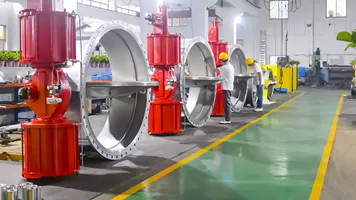
TIANYU’s 40,000 m² manufacturing facility specializes in custom-engineered gate and globe valves, combining 20 years of valve expertise with in-depth knowledge of international industry requirements. From API 600 gate valves for oil pipelines to FDA-compliant globe valves for pharmaceuticals, TIANYU delivers valves tailored to each client’s unique needs—backed by rigorous testing and global support.
VII.A. Customization Capabilities
TIANYU’s end-to-end customization process ensures valves match application requirements precisely, eliminating the “one-size-fits-all” compromises of off-the-shelf products:
-
Size Range: DN15–DN1200 for gate valves, DN15–DN600 for globe valves—with special designs available for DN2000+ large-diameter applications.
-
Material Options: Body materials (ductile iron, 304/316L stainless steel, duplex 2205), seat materials (EPDM, PTFE, Stellite 6), and stem materials (17-4 PH stainless steel) selected for fluid compatibility and durability.
-
Design Features: Trunnion-mounted or resilient-seated gate valves; Z-pattern, Y-pattern, or angle-pattern globe valves; rising or non-rising stems; manual, pneumatic, or electric actuation (compatible with Siemens, Emerson actuators).
-
Compliance Tailoring: Valves certified to API 600, API 6D, ANSI B16.34, FDA 21 CFR 177, NSF/ANSI 61, WRAS, and ATEX—ensuring market access in North America, Europe, Asia, and the Middle East.
VII.B. Quality Control and Testing
Every TIANYU valve undergoes 16 quality checks before shipment, with 100% testing for critical performance parameters:
-
Hydrostatic Testing: 1.5x rated pressure for 30 minutes (no leakage allowed) per API 598.
-
Leakage Testing: ANSI/FCI 70-2 Class VI testing for elastomeric-seated valves; Class IV for metal-seated versions.
-
Material Testing: Spectral analysis for metal composition, hardness testing (Rockwell C for Stellite seats), and tensile strength testing.
-
Environmental Testing: 1,000-hour salt spray testing (ASTM B117), temperature cycling (-40°C to 450°C), and vibration testing (ISO 16750) for harsh conditions.
VII.C. Performance Enhancements
TIANYU integrates proprietary design improvements to exceed industry standards:
-
Gate Valves: Flexible wedge design with precision-machined seating surfaces (Ra 0.8 μm) reduces binding by 40% in thermal cycling applications. Full-port bore with smooth internal surfaces (Ra 1.6 μm) minimizes pressure drop and energy use.
-
Globe Valves: Cage-guided design with interchangeable discs/seats reduces maintenance time by 50%—components can be replaced without removing the valve from the pipeline. Y-pattern flow path with optimized geometry cuts pressure drop by 25% compared to standard Z-pattern designs.
VII.D. Global Support and Service
TIANYU’s commitment to client success extends beyond valve delivery, with support tailored to international operations:
-
On-Site Support: Certified technicians in 50+ countries assist with installation, calibration, and maintenance—reducing downtime and ensuring optimal performance.
-
Spare Parts Inventory: Global warehouses in the U.S., Germany, and China stock critical components (seats, stems, cages) for next-day delivery.
-
Warranty: 5-year warranty for gate valves, 3-year warranty for globe valves—double the industry average—covering material defects and performance failures.
-
Training: Customized training programs for operators and maintenance teams, covering valve operation, troubleshooting, and compliance documentation.
VIII. Conclusion
Gate and globe valves are both essential industrial components, but their distinct designs make them suited for fundamentally different tasks: gate valves excel at unobstructed on/off shutoff in large-diameter, high-flow systems, while globe valves provide precise throttling and tight shutoff in process applications. The key to successful valve selection is aligning design strengths with application requirements—avoiding the costly mistakes of using a gate valve for throttling or a globe valve for mainline isolation.
TIANYU’s custom gate and globe valves bridge the gap between standard products and unique industrial needs, delivering performance, compliance, and cost-effectiveness for international clients. By combining in-depth technical expertise with rigorous quality control and global support, TIANYU ensures that every valve meets the exacting standards of industries ranging from oil and gas to pharmaceuticals.
As industrial systems evolve to become more efficient and sustainable, the role of properly selected valves becomes even more critical. Whether optimizing energy use with a full-port gate valve or ensuring product quality with a precision globe valve, TIANYU’s solutions empower clients to build reliable, cost-effective systems that stand the test of time.
TIANYU’s custom gate (DN15–DN1200) and globe (DN15–DN600) valves excel in global industries. 316L/duplex bodies and Stellite/PTFE seats ensure durability (100,000+ cycles for gates, 50,000+ for globes). API 600/FDA/NSF certifications meet strict standards. Gate valves cut energy use by 80% via full-port design; globe valves offer ±2% flow precision. 5-year warranties, 24/7 global support, and in-line maintenance features reduce TCO by 30% vs. off-the-shelf options.